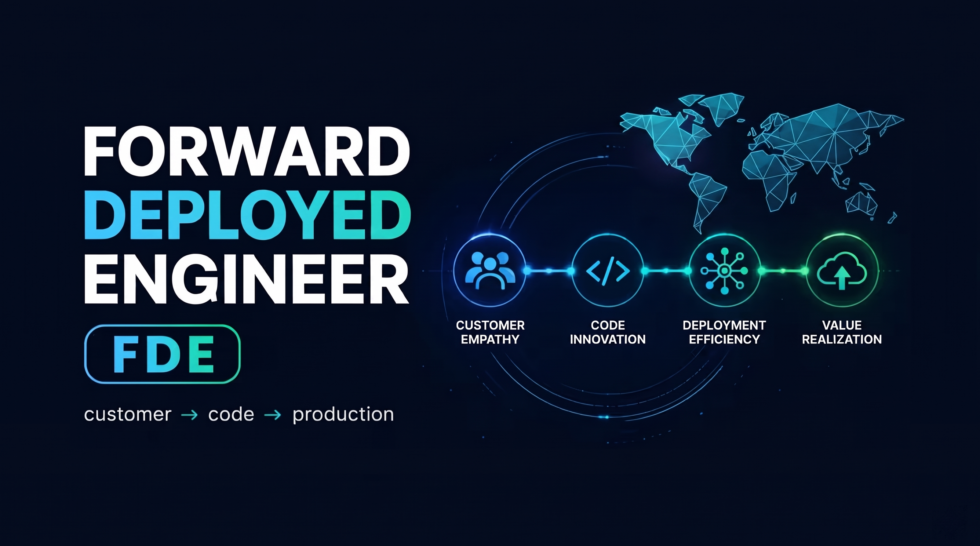
Forward Deployed Engineer (FDE): Bridging the Gap Between Technology and Business Outcomes
What if the biggest challenge in enterprise technology isn’t building innovative solutions, but making them work in the real world?
Businesses are investing heavily in Artificial Intelligence (AI), automation, cloud computing, and advanced software. Yet, turning these technologies into practical, scalable solutions that deliver measurable business value remains a significant challenge.
A solution may perform perfectly during development but struggle when integrated with complex enterprise systems, legacy infrastructure, or everyday business workflows.
This is where Forward Deployed Engineers (FDEs) come into the picture.
By combining hands-on engineering expertise with business understanding, FDEs help organizations move beyond technology experimentation toward real-world implementation and measurable outcomes.
What Is a Forward Deployed Engineer (FDE)?
A Forward Deployed Engineer (FDE) is a customer-facing software engineer who works closely with an organization’s teams to design, develop, integrate, and deploy technology solutions tailored to specific business challenges.
Unlike traditional engineering roles that primarily focus on software development, FDEs are directly involved in understanding business requirements and ensuring solutions work effectively within real operational environments.
Their role combines elements of:
Software Engineering: Building and customizing applications.
Solution Architecture: Designing systems that integrate with existing infrastructure.
Technical Consulting: Translating business challenges into technical solutions.
Deployment and Optimization: Implementing, troubleshooting, and improving solutions in production.
What makes FDEs different is their ability to connect technical execution with business outcomes.
Why Are Forward Deployed Engineers Gaining Importance?
As enterprise technology becomes more sophisticated, businesses need engineers who can do more than develop software.
Three major factors are driving the relevance of Forward Deployed Engineering.
1. AI Is Moving From Experimentation to Implementation
Building an AI prototype is relatively straightforward compared with deploying it across an enterprise.
Production environments require secure data integration, reliable performance, governance, and scalability. FDEs help bridge this implementation gap.
2. Businesses Need Faster Technology Deployment
Traditional technology projects often involve multiple handoffs between consultants, architects, developers, and implementation teams.
FDEs can reduce these gaps by working directly with stakeholders throughout development and deployment.
3. Enterprise Solutions Require Customization
Every organization has unique systems, workflows, and operational requirements.
Forward Deployed Engineers help adapt technology to these environments through custom development, integrations, and continuous optimization.
What Does a Forward Deployed Engineer Actually Do?
FDEs work across the technology implementation lifecycle, connecting business needs with engineering execution.
Their key responsibilities include:
Understanding Business Challenges: Working with stakeholders to identify requirements, technical constraints, and expected outcomes.
Designing and Developing Solutions: Building applications, APIs, integrations, and customized software components.
Integrating Enterprise Systems: Connecting new technology with existing databases, cloud platforms, and business applications.
Deploying and Optimizing: Supporting production deployment, troubleshooting, performance, and reliability.
Collaborating and Improving: Gathering user feedback and refining solutions to meet evolving business needs.
Unlike roles focused primarily on delivering predefined features, FDEs often take broader ownership of how technology performs in real-world environments.
Forward Deployed Engineer vs. Software Engineer vs. IT Consultant
Although these roles overlap, their primary focus and working models differ.
Aspect
Forward Deployed Engineer
Software Engineer
IT Consultant
Primary focus
Customer-specific implementation
Software development
Technology strategy and solutions
Client interaction
Typically high
Varies
Typically high
Hands-on coding
Core responsibility
Core responsibility
Depends on role
Business involvement
Direct and continuous
Varies
Strong
Deployment ownership
Often end-to-end
Depends on team
Depends on engagement
The key distinction is that FDEs combine customer collaboration, hands-on development, and implementation ownership within a single role.
The Role of Forward Deployed Engineers in AI and Enterprise Technology
Forward Deployed Engineering is particularly relevant to enterprise AI, where moving from a successful prototype to a reliable production system requires specialized expertise.
FDEs can contribute to:
Generative AI and LLM Integration: Developing enterprise AI applications and connecting language models with business systems.
Retrieval-Augmented Generation (RAG): Building AI solutions that securely retrieve and use relevant organizational information.
AI Agents and Workflow Automation: Developing intelligent workflows with appropriate security controls, monitoring, and human oversight.
Cloud and Enterprise Integration: Connecting applications, APIs, databases, and infrastructure to support scalable deployment.
A Practical Example
Consider a financial services organization developing an AI-powered customer support assistant.
The prototype works well, but production deployment presents challenges: customer data exists across multiple systems, sensitive information requires protection, and the solution must integrate with an existing CRM platform.
A Forward Deployed Engineer works with the organization’s teams to build secure integrations, implement access controls, refine AI workflows, and support deployment.
The result is not merely a functioning AI model, but a solution designed to operate within the organization’s business environment.
This is an illustrative scenario.
That is the real value of Forward Deployed Engineering: turning technological capabilities into practical business solutions.
Key Business Benefits of Forward Deployed Engineering
When implemented effectively, the FDE model can help organizations achieve:
Faster Time-to-Value: Reducing communication gaps and accelerating implementation decisions.
Better Business Alignment: Developing solutions around actual operational challenges.
Seamless Integration: Addressing compatibility and infrastructure requirements early.
Greater Flexibility: Customizing solutions to meet enterprise-specific needs.
Improved Accountability: Maintaining clearer ownership from development through deployment.
These benefits depend on effective collaboration, clearly defined responsibilities, and appropriate technical governance.
When Should Businesses Consider a Forward Deployed Engineer?
The FDE model is especially useful for projects requiring complex integrations, extensive customization, and close collaboration between business and engineering teams.
Common scenarios include:
Deploying enterprise AI and GenAI solutions.
Modernizing legacy applications and infrastructure.
However, not every project requires an FDE. For standardized development or well-defined software requirements, traditional engineering teams may be equally effective.
How Forward Deployed Engineering Connects With IT Consulting and Staff Augmentation
The growing importance of FDEs reflects a broader change in enterprise technology delivery: businesses need engineering expertise that can translate technical strategies into working solutions.
This creates a natural connection with three key IT service models.
IT Consulting: From Strategy to Execution
IT consulting helps organizations evaluate technology challenges, define architectures, and establish implementation roadmaps.
Forward-deployed engineering practices can complement this process by connecting strategic recommendations with hands-on implementation.
IT Staff Augmentation: Access to Specialized Expertise
Organizations may lack the internal resources or specialized skills required for complex AI, cloud, and software projects.
IT Staff Augmentation enables businesses to expand their engineering teams with professionals who collaborate directly with internal stakeholders.
When combined with clear delivery ownership and customer-facing responsibilities, this approach can support FDE-style engagements.
Custom Software Development: Solutions Built Around Business Needs
Custom Software Development focuses on creating applications and integrations tailored to organizational requirements.
Forward-deployed engineering practices can strengthen this approach through closer stakeholder collaboration, continuous feedback, and implementation-focused development.
Together, these models help businesses bridge the gap between technology planning and execution.
How DevLabs Technology Supports Enterprise Engineering Needs
As organizations adopt advanced technologies, having the right engineering expertise and delivery model becomes increasingly important.
At DevLabs Technology, we support businesses through our core services:
IT Consulting: Helping organizations align technology decisions with business requirements and implementation priorities.
IT Staff Augmentation: Providing flexible access to engineering talent to strengthen development teams and support technology initiatives.
Custom Software Development: Building tailored software applications and solutions that address specific business challenges.
The principles behind Forward Deployed Engineering—close collaboration, practical problem-solving, and outcome-oriented delivery—reinforce the importance of combining technical expertise with a clear understanding of business needs.
Whether businesses are modernizing applications, expanding engineering capabilities, or implementing emerging technologies, DevLabs Technology helps connect their technology requirements with practical engineering solutions.
The Future of Forward Deployed Engineering
As AI adoption accelerates and enterprise systems become more interconnected, engineers who combine technical expertise with business understanding are likely to become increasingly valuable.
Forward Deployed Engineering reflects three important shifts:
From isolated software development to collaborative problem-solving.
From technology experimentation to production-ready implementation.
From measuring technical delivery alone to evaluating business outcomes.
The future may not require every organization to hire professionals with the title Forward Deployed Engineer. However, more engineering teams may adopt the same principles of customer collaboration, implementation ownership, and continuous improvement.
Conclusion: Beyond Coding, Toward Business Impact
The real challenge in enterprise technology is not simply building advanced solutions. It is ensuring those solutions work effectively, integrate seamlessly, and create meaningful business value.
Forward Deployed Engineers bridge this gap by bringing software engineering, business understanding, and hands-on implementation together.
As businesses accelerate AI adoption and digital transformation, the demand for engineering approaches that prioritize real-world outcomes will continue to evolve.
At DevLabs Technology, we help organizations address complex technology challenges through IT Consulting, IT Staff Augmentation, and Custom Software Development.
Frequently Asked Question
01 What is a Forward Deployed Engineer?
A Forward Deployed Engineer is a customer-facing software engineer who designs, develops, integrates, and deploys technology solutions tailored to specific business requirements.
02 How is an FDE different from a Software Engineer?
While both roles involve coding, FDEs typically work more closely with customers and take broader responsibility for implementation, integration, and business-specific outcomes.
03 Why are Forward Deployed Engineers important for AI?
They help organizations move AI solutions from prototypes to production by addressing integration, security, reliability, and operational requirements.
04 Can IT Staff Augmentation support Forward Deployed Engineering?
Yes. Staff augmentation can provide specialized engineers who work closely with internal teams, provided the engagement includes the necessary implementation expertise, collaboration, and delivery ownership.